← All issues
published
78 articles
2026-03-26
Neuroscience
Scientists Found An Off Switch For Runaway Brain Signals And It Actually Works
Journal of Neuroscience · 2026-03-21
Your brain sends electrical signals — like messages — between neurons, the tiny cells that run everything you think and do. In epilepsy, those messages stop being messages and start being a fire alarm that won't turn off, firing over and over when they shouldn't. Scientists injected a molecule called Ant-134 directly into the brains of mice that had epilepsy and couldn't be helped by normal medicine. Afterward, the neurons in a part of the brain called the hippocampus — which is shaped like a shrimp and handles memory — calmed down, sent fewer runaway signals, and the seizures happened less often.
The takeaway
Your brain has a volume dial, and scientists just found out they can turn it down.
Read the paper ↗
Biology
Your Cells Have Been Making Typos This Whole Time And Nobody Stopped Them
PLOS Biology · 2026-03-19
When your cells copy instructions from your DNA to make proteins, they are supposed to follow the instructions exactly. It turns out they have been making small mistakes — called RNA processing errors — basically the whole time. Scientists looked at 166 sets of cell data from 75 different animals and found that species with more individual animals in them make fewer of these mistakes. That is because when there are more animals, natural selection — the process that removes bad traits over time — has more chances to catch and delete the errors. Species with smaller populations just... keep the typos.
The takeaway
Your cells have been submitting drafts with typos since you were born and your body just ran with it.
Read the paper ↗
Biology
Scientists Taught DNA To Read Proteins By Working Completely Backwards
Nature Biotechnology · 2026-03-21
Your body is full of proteins called peptides — tiny strings of amino acids that do basically everything, like run your immune system and tell your stomach it's full. Scientists have always been able to read DNA, but reading peptides was much harder. Now researchers have figured out how to run the whole thing in reverse: they take each amino acid in a peptide, one at a time, and convert it into a piece of DNA with a unique barcode — like tagging each ingredient in a recipe with its own QR code. Once the whole peptide has been translated into DNA, they can read the DNA the normal way and work out exactly what the peptide was.
The takeaway
Your cells have been writing in a language scientists could not read, so scientists invented a photocopier that runs backwards.
Read the paper ↗
Medicine & Health
Scientists Found A Tiny Drug That Fits Into A Broken Cancer Protein Like A Key
Nature Medicine · 2026-03-25
Your cells have a protein called p53 whose whole job is to stop tumors from growing — basically the hall monitor of your body. In some cancers, p53 breaks in a specific way called the Y220C mutation, which leaves a small hole in it and makes it stop working. Scientists found a tiny drug called rezatapopt that fits exactly into that hole, like a Minecraft block snapping into a gap, and when it does, p53 starts working again. A first-round trial in patients showed this actually happens in real humans, not just in a lab dish.
The takeaway
Your cells have a broken security guard, and scientists spent years making a very small key to fix it.
Read the paper ↗
Medicine & Health
Scientists Used a Tiny Spell-Checker to Fix a Broken Gene Inside a Person
NEJM · 2026-03-26
Your DNA is basically a massive instruction manual — billions of letters long — and sometimes one letter is wrong. That one wrong letter can cause a disease called chronic granulomatous disease, where your immune cells show up to fight an infection and then just stand there doing nothing, like an NPC that forgot its code. Scientists just used a technique called prime editing — which works like a find-and-replace tool, but for the inside of your actual cells — to go in and fix the broken letter in real patients.
The takeaway
Your entire immune system was waiting on a typo.
Read the paper ↗
Physics
Scientists Built A New Machine That Caught A Metal Breaking A Rule Of Physics
Nature Physics · 2026-03-25
There is a rule in physics that says if you run time backwards, most things should look the same. A kagome metal — a material whose atoms are arranged in a pattern that looks like a net of triangles — has been caught breaking that rule. Scientists built a new tool called magnetoARPES, which fires light at a material while a magnet is running, and used it to watch the metal's electrons behave differently depending on which direction the magnetic field pointed. That difference is the evidence: something inside this metal is not running the same in both directions, and now there is a machine that can see it happening.
The takeaway
Your universe has a rule about running time backwards, and this metal has been ignoring it the whole time.
Read the paper ↗
Physics
Scientists Build A Camera That Can Watch Electrons Move In Real Time
Nature Physics · 2026-03-15
Electrons — the tiny charged particles zipping around inside every atom in your body — move incredibly fast and incredibly small. Until now, no camera came close to catching them in the act. Scientists have built a new kind of detector using a free-electron laser, which is a machine that fires pulses of X-ray light so short they last only a femtosecond — that is one millionth of one billionth of a second, which is not a real amount of time your brain will accept but is in fact correct. By crossing two of these X-ray pulses to make a kind of light grid, they can now watch electrons moving around at the scale of a single atom.
The takeaway
A machine the size of a building is now watching things the size of nothing, and it is working.
Read the paper ↗
Chemistry
Your Solar Panel Has Been Moving Electrons The Wrong Distance This Whole Time
Nature Chemistry · 2026-03-25
When sunlight hits a solar panel, it knocks electrons loose — and those electrons need to travel across a tiny border between two materials called the donor-acceptor interface. Scientists just figured out that how far those electrons travel is controlled by something called the driving force, which is basically how hard the material is pushing them. If the push is too weak, the electrons don't go far enough, and the solar panel wastes energy. Researchers found that the fix is to raise something called the dielectric constant — a measure of how well a material can spread out electric charge — which lets electrons travel the right distance without getting lost.
The takeaway
Solar panels have been moving electrons the wrong distance, and the material itself was in charge of that the whole time.
Read the paper ↗
Chemistry
Biochemistry
Your Cells Have a Tiny Squeeze Machine That Decides When to Stop Making Stuff
Biorxiv · 2026-03-20
Inside every one of your cells, there is an enzyme — a tiny protein worker — called ATCase, and its entire job is to help build the chemical parts your cells need to copy DNA. Scientists used to think this worker had two modes: on and off. It does not. Researchers used three different types of giant microscopes to watch ATCase closely, and it turns out the enzyme works more like a balloon — when it squishes down, it slows itself and stops making more of what your cell already has too much of. When it puffs back out, it gets going again. The squishing and puffing are controlled by the exact chemicals the enzyme is building, so when there is enough of something, those chemicals literally squeeze the machine shut.
The takeaway
Your cells have been running a squeeze-based self-checkout system this whole time without telling you.
Read the paper ↗
Chemistry
The Water In Your Glass Has Been Secretly Starting Fights With CO2
Nature Chemistry · 2026-03-21
Scientists thought that when electricity is used to break apart CO2 — carbon dioxide, the gas you breathe out — all the action happened at the surface of the metal electrode, like a very boring handshake between the metal and the gas. New research found that the water in the mix was not just sitting there. It was turning into radicals — unstable, aggressive versions of itself — and attacking the CO2 before it even got to the electrode. The water was starting the fight early, in the middle of the liquid, without asking anyone.
The takeaway
The water was not a bystander. It was a participant. It has always been a participant.
Read the paper ↗
Astronomy & Astrophysics
The Universe Has Been Secretly Refilling Its Gas Tank For 12 Billion Years
Nature Astronomy · 2026-03-15
Scientists pointed their telescopes at the whole entire universe and measured the gas — specifically the kind of gas that turns into stars — going all the way back 12 billion years. What they found is that the universe has a reservoir of molecular gas, which means a giant invisible tank of star-building material, and that tank keeps getting refilled. Not slowly. Rapidly. Like a juice box that somehow never runs out. The gas gets used up making stars, and then more gas shows up, and then more stars get made, and this has been happening since before the Earth existed.
The takeaway
The universe has been running on a gas tank that refills itself, and nobody asked it to stop.
Read the paper ↗
Chemistry
Scientists Built A Chain So Long It Broke The Previous Record By 10x
Nature Chemistry · 2026-03-16
You know how in Minecraft you can only build so far before the game just stops you? Scientists had the same problem with a material called poly(para-phenylene) — a chain of carbon rings linked together. The old method, called Ullmann coupling, would just quit after about 100 nanometres, which is so small it makes a human hair look like a school bus. Now researchers have figured out a new way to build these chains called radical ring-opening polymerization, and the chains come out a full micrometre long — ten times longer than before. Those extra-long chains can then be used to grow something called biphenylene nanoribbons, which are a type of carbon structure where the rings are not the normal six-sided shape.
The takeaway
Your pencil is made of carbon. Scientists just figured out how to build carbon chains that are ten times longer by changing the order they snap the pieces together.
Read the paper ↗
Astronomy & Astrophysics
A Star Has Been Holding Onto The Universe's Original Recipe This Whole Time
Nature Astronomy · 2026-03-16
Scientists found a star sitting in a tiny, ancient dwarf galaxy that has been quietly storing the leftovers from the very first stars that ever exploded — like a lunchbox that has been sealed since before your school existed, or your parents existed, or Earth existed. The star is almost completely missing heavy elements — the stuff like iron and gold — but it is absolutely packed with carbon, which is the same element that makes up pencils, diamonds, and you. This means the first stars in the universe did not go out in giant, dramatic explosions. They fizzled. And that fizzle is apparently what started all of chemistry.
The takeaway
The universe's first recipe was mostly carbon, delivered by an explosion that was, by explosion standards, pretty underwhelming.
Read the paper ↗
Astronomy & Astrophysics
A Rock From Space Had All The Ingredients For Life Sitting In It The Whole Time
Nature Astronomy · 2026-03-17
Scientists analyzed a chunk of asteroid Ryugu — a space rock that has been floating around since before Earth existed — and found all five nucleobases inside it. Nucleobases are the building blocks of DNA and RNA, the instruction manuals your cells use to build you. The same five pieces that spell out every living thing on this planet were just sitting in a rock in space. Researchers think asteroids like Ryugu may have delivered these ingredients to early Earth, a long time before anything was alive to notice.
The takeaway
The recipe for life was in a rock. The rock was in space. Nobody asked it to be there.
Read the paper ↗
Climate & Earth Sciences
The Ocean Spent Ten Years Getting Warm Before It Finally Melted The Ice
Nature Climate Change · 2026-03-21
Between 2015 and 2017, a huge chunk of Antarctic sea ice disappeared. Scientists looked into it and found that the ocean had been quietly setting this up for a decade beforehand. A layer of cold water called Winter Water — which normally acts like a shield between the ice above and the warm deep water below — had been getting thinner and thinner since 2005. Then strong winds showed up, pushed things around, and suddenly the warm deep water underneath had a clear path straight to the ice. The ice did not survive this.
The takeaway
Your ocean had a ten-year plan and did not tell anyone about it.
Read the paper ↗
Neuroscience
Your Brain Has Been Deciding Whether To Huddle Since Before You Could Ask It
Nature Neuroscience · 2026-03-21
Scientists made mice cold and then watched what their brains did about it. The part of the brain called the prefrontal cortex — the bit that handles decisions, like whether to do your homework or just sit there — turns out to be the one choosing when to huddle up with the group. When researchers switched that brain region off in some mice, the other mice in the group automatically huddled more to make up for it, even though nobody told them to. The mice whose brains got turned off did not have to do anything. Their friends just covered for them.
The takeaway
Your brain is already managing your huddling schedule and has not once sent you a notification about it.
Read the paper ↗
Biology
Scientists Grew A New Throat Tube In A Lab And Put It In A Pig
Nature Biotechnology · 2026-03-21
Your esophagus is the tube that carries food from your mouth to your stomach. It is doing this right now, without asking you. Scientists have now built one of these tubes in a lab — using the pig's own cells — and installed it into a live minipig, where it worked. The engineered tube was made from the animal's own material, which means the pig's body did not try to reject it the way it would a foreign object.
The takeaway
Somewhere out there, a minipig has a lab-grown throat and is eating lunch with it.
Read the paper ↗
Biology
Your T-Cells Have Been Getting Sugar-Coated Into Uselessness This Whole Time
eLife · 2026-03-20
Your immune system has special cells called CD8+ T-cells — think of them as the delete button for cancer cells. For the delete button to work, two parts of the cell have to connect: a sensor called TCR and a helper called CD8. Scientists discovered that an enzyme called B4GALT1 coats both parts in a type of sugar called galactose, and that sugar coating stops TCR and CD8 from connecting properly. When researchers switched B4GALT1 off using a gene-editing tool called CRISPR — which works like a very precise pair of scissors for DNA — the T-cells connected better and deleted more cancer cells. They also found that patients whose tumors had more B4GALT1 activity in their T-cells had worse outcomes.
The takeaway
Your immune cells have been getting sugared into underperforming since before you could read this sentence.
Read the paper ↗
Physics
Scientists Confirm That Particles Can Lose Their Weight By Looking At Light
Nature Physics · 2026-03-16
Inside certain super-thin materials — sheets so thin they are basically just one layer of atoms — scientists found something strange happening to excitons. An exciton is a tiny particle made of two opposite charges stuck together, like two magnets that grabbed onto each other. Normally, excitons have mass, meaning they move around like a regular object with weight. But when light gets involved, the excitons stop having mass entirely and start moving like photons — the particles that make up light — which famously have zero mass and travel in perfectly straight lines. Scientists confirmed this by watching it happen in a lab.
The takeaway
Your atoms contain particles that can lose all their weight just by being near light.
Read the paper ↗
Neuroscience
Your Brain Files Reward Memories Completely Differently Depending On How Old You Are
Journal of Neuroscience · 2026-03-21
Scientists scanned the brains of kids and adults aged 8 to 25 while they tried to remember things that came with a reward. They were looking at the hippocampus — the part of your brain in charge of storing memories, about the size of your thumb and buried somewhere behind your ears. Here is what they found: kids' brains remembered reward stuff better when the memory changed a little over time, like a file that keeps getting edited. Adults' brains did the opposite — they remembered better when the memory stayed exactly the same, like a file that gets locked.
The takeaway
Your brain has been using a completely different filing system this whole time and did not tell you.
Read the paper ↗
Neuroscience
Systems Neuroscience
Your Brain Has Been Running A Fever Since Menopause Started And Nobody Told You
Biorxiv · 2026-03-25
Deep inside your brain is a tiny control room called the hypothalamus — it handles temperature, hormones, and a bunch of other stuff you never agreed to let it manage. Scientists removed the ovaries from mice, which cut off their estrogen supply, then watched what happened to that control room over four months. The control room caught fire. Not literally — but the brain tissue started showing signs of inflammation, the glial cells (the brain's cleanup crew) went into full emergency mode, and a specific set of neurons called KNDy neurons started behaving strangely. When the researchers compared this to data from actual human women aging through menopause, the pattern matched almost exactly.
The takeaway
Your hypothalamus has been quietly inflaming itself for years and filed zero reports about it.
Read the paper ↗
Biology
This Worm Lays Its Eggs Through Its Mouth And Scientists Are Reporting This Calmly
eLife · 2026-03-20
Scientists spent a long time watching a tiny worm called Hofstenia miamia do its whole life, start to finish. They found that this worm grows its body parts in a specific order based on how big it is — like unlocking levels. If the worm gets badly injured, it regrows those same parts in the same order. If it stops eating and starts shrinking, it loses them in reverse order, like un-crafting. The worm also lays eggs for months after mating just once, even though it has nowhere to store the other worm's stuff — scientists do not currently know where it is keeping it.
The takeaway
The worm lays eggs through its mouth and has been doing this the whole time.
Read the paper ↗
Biology
Your Nerves Have Been Running A Pain Program In The Background This Whole Time
eLife · 2026-03-18
You know that feeling when something hurts for way too long, even after the actual bad thing is over? Scientists studying mice found out why that happens — and it is coming from the neurons — the tiny messengers your body uses to carry signals — that are supposed to be turning the pain *down*. Those neurons keep making new proteins from a type of instruction called mRNA, and those proteins keep the pain going. The pain is not a glitch. It is a program your own nervous system is running on purpose.
The takeaway
Your body's pain-off switch has been secretly keeping the pain on.
Read the paper ↗
Biology
The New Virus On The Block Is Way More Dangerous Than The Regular One
PLOS Biology · 2026-03-19
Scientists have been tracking which germs are most likely to jump from animals into humans and start spreading. The obvious guess was: the ones that do it the most. More practice, more danger, right? Wrong. It turns out how often a pathogen — a germ that can make you sick — spills over into a new host does not actually tell you how risky it is. What matters is whether the germ is new. A pathogen that just started showing up, or one that recently changed its shape, is way more likely to actually stick around and spread than one that has been doing the same failed invasion attempt for years.
The takeaway
Your immune system has seen the regular villain before. It's the new one that gets through.
Read the paper ↗
Biology
Evolutionary Biology
Scientists Mixed Two Plant Families Together And One Got Almost Three Times Stronger
Biorxiv · 2026-05-24
There is a rare prairie plant that grows in small, separate groups. Scientists took pollen from one group and used it on a different group — basically setting up a playdate between plants that had never met. The baby plants from these cross-group matches grew up to be way more successful than the ones whose parents were from the same group. One population's offspring were 281% stronger. That is not a typo. The plants that stayed in their own group were just okay. The plants that mixed were built different.
The takeaway
Your family tree, it turns out, gets stronger every time someone new joins it.
Read the paper ↗
Medicine & Health
Scientists Tested Two Diabetes Pills and One of Them Made Stomachs Very Upset
The Lancet · 2026-03-21
There is a pill called orforglipron. There is another pill called semaglutide. Both pills help lower blood sugar in adults whose diabetes was not being controlled by the medicine they were already taking. Scientists gave people one pill or the other for 52 weeks — one full year — and measured what happened. Orforglipron did at least as well as semaglutide at lowering blood sugar, and actually did slightly better. The catch is that more people taking orforglipron had stomach problems, more people quit because of side effects, and their heart rates went up more.
The takeaway
The pill that worked better for blood sugar also made more people's stomachs stage a protest.
Read the paper ↗
Medicine & Health
Richer Parts of Europe Have Cleaner Air and Scientists Have the Receipts
Nature Medicine · 2026-03-21
Scientists looked at 653 regions across 31 European countries to figure out why some people are dying from dirty air more than others. What they found is that poorer regions — the ones that also haven't switched to wind and solar power yet — have the worst air pollution deaths. The regions moving fastest toward renewable energy had fewer people dying from the air they breathe. Your lungs, it turns out, care a lot about where you were born.
The takeaway
The air that kills you is not randomly distributed. It follows the money.
Read the paper ↗
Physics
Scientists Figure Out How To Measure Something Weird Using Only One Of It
Nature Physics · 2026-03-15
Quantum entanglement — a thing that happens when two tiny particles are linked so that what happens to one instantly affects the other, no matter how far apart they are — is very hard to measure. Normally, scientists need a huge pile of identical quantum states, which are basically the settings a particle can be in, just to run their numbers. A new method can now measure how entangled something is using only a single copy of that quantum state. Scientists built this because having a giant pile of identical quantum states is, it turns out, not always an option.
The takeaway
Quantum scientists have been asking for a second copy this whole time and nobody told them they could just use the one.
Read the paper ↗
Physics
Scientists Built A Light Comb You Can Control With A TV Remote Signal
Nature Physics · 2026-03-15
Light can be arranged into a comb — not a hair comb, but a pattern of very precise, evenly-spaced colors lined up in a row. Scientists have now built one of these light combs out of a material called lithium niobate, which is a type of crystal, and figured out how to control it using microwave signals — the same kind of signal your microwave oven runs on. For a long time, nobody had really studied how these combs behave, which meant nobody could make them do much. Now they can program the comb, like changing which colors show up and when, just by adjusting the microwave going in.
The takeaway
A crystal the size of a fingernail has been taking orders from microwave signals this whole time.
Read the paper ↗
Physics

Scientists Build A Tiny Quantum Game Where Particles Jump Over Each Other's Heads
Nature Physics · 2026-03-17
In normal physics, particles called bosons — which are basically the friendly, sharing type of particle — are only supposed to hop to the spot right next to them, like moving one square at a time in a board game. Scientists have now built a simulator where special particles called dipolar excitons break that rule and jump further, skipping over their neighbors entirely. The whole setup is called the Bose-Hubbard model, which is a kind of rulebook for how quantum particles crowd together and move around. This experiment shows the rulebook can be rewritten, and the particles will just go along with it.
The takeaway
Particles that were only supposed to move one square at a time have been skipping ahead the whole time.
Read the paper ↗
Physics
Scientists Found A Setting On Quantum Machines That Makes Them Way Better At Their Job
Nature Physics · 2026-03-21
You know how a spinning top is easiest to knock over right before it falls — that one wobbly moment where it could go either way? Quantum machines have a moment like that too, called a bistable transition point, which is the exact instant where the device can't decide which of two states it's in. Scientists ran experiments on a hybrid quantum system — a device built from two different types of quantum parts joined together — and found that operating it right at that wobbly tipping point made it dramatically better at detecting tiny signals. The machine gets more sensitive precisely because it's on the edge of a decision it hasn't made yet.
The takeaway
Your quantum sensor works best at the exact moment it is about to break down.
Read the paper ↗
Physics
Scientists Built A Computer That Works By Measuring Things Until It Gets The Answer
Nature Physics · 2026-03-15
Normal computers run programs by doing steps in order, like following a recipe. This computer does it differently: scientists start with a bunch of particles tangled together in a special way — called a cluster state — and then just... measure them, one after another, until the answer comes out. That is the whole plan. They got it to work on a real quantum processor made of superconducting chips, which are kept colder than outer space so the particles behave themselves.
The takeaway
A computer that runs entirely on looking at things has now been confirmed to exist in a lab.
Read the paper ↗
Physics
Your Metal Is Acting Weird And Scientists Finally Know Whose Fault It Is
Nature Physics · 2026-03-17
Some metals do not behave like metals are supposed to. Electricity moves through them in a way that does not follow the normal rules, and for a long time nobody knew why. Scientists looked at a special type of metal built on a pattern called a kagome lattice — imagine a net made of triangles inside hexagons, tiled forever — and found that the electrons inside are cancelling each other out like two sound waves crashing and going silent. This cancellation squishes the electrons into tiny, compact blobs called compact orbitals, and those blobs are what makes the metal go weird.
The takeaway
The metal was misbehaving because its own electrons were cancelling each other out, and nobody checked until now.
Read the paper ↗
Chemistry
Scientists Build a Molecule That Your Body's Virus-Fighters Might Actually Want
Nature Chemistry · 2026-03-15
Deep inside chemistry labs, scientists have been building a very specific kind of molecule called a sulfinamide — basically a tiny structure made of sulfur, nitrogen, and some other bits, shaped in a way that matters a lot. The problem is that molecules like this come in two versions that are mirror images of each other, like your left and right hand, and only one version works the way you want. Researchers figured out how to build the correct version on purpose, using a special catalyst — a helper molecule that speeds up the reaction without getting used up — made from a spiral-shaped chunk of phosphorus that doesn't fall apart when it touches air. The molecules they made this way showed early signs of being useful against viruses.
The takeaway
A spiral molecule has been quietly doing chemistry's hardest homework, and it doesn't even need to be kept in a special box.
Read the paper ↗
Chemistry
Biochemistry
Your Muscles Have Been Running On Low Battery This Whole Time And Nobody Told You
Biorxiv · 2026-03-19
Scientists took muscle samples from people who don't exercise much and compared them to people who do. The sedentary group — the ones who sit down a normal amount — had mitochondria running at about 64% power. Mitochondria are the tiny parts of your cells in charge of turning food into energy, like a crafting table that converts ingredients into something useful. Their muscles were also 49% worse at getting pyruvate — a fuel your cells make when you eat — through the door and into the furnace. During exercise, their bodies produced more than 60% extra blood lactate, which is the chemical your muscles dump when they're overwhelmed and just start making a mess instead.
The takeaway
Your muscles have been running a low-power mode you never turned on.
Read the paper ↗
Chemistry
Your DNA Has Been Moonlighting As Bait This Whole Time
Nature Chemistry · 2026-03-17
Scientists figured out how to engineer a special kind of DNA — called retron DNA — so that it acts like a trap. Instead of doing the usual DNA thing of storing instructions for building you, this DNA just sits there and attracts specific proteins, the way a piece of pizza on the floor attracts literally everyone at lunch. The proteins show up, grab onto the DNA bait, and then scientists can use that to control what happens inside the cell. This works without the DNA needing to be a gene — meaning it has no genetic job, no instructions, no role in making you who you are. It is just bait.
The takeaway
Some of your DNA has a job. This DNA was engineered to have no job except to stand there and look attractive to proteins.
Read the paper ↗
Astronomy & Astrophysics
A Galaxy Left Chemical Clues About Its Entire Life And Scientists Actually Read Them
Nature Astronomy · 2026-03-25
Scientists made a detailed map of oxygen — yes, oxygen — spread across a spiral galaxy called NGC 1365, which is very far away and shaped like a pinwheel with a bar through the middle. It turns out that where oxygen ends up inside a galaxy is not random: it leaves a kind of fingerprint that records every crash, merger, and growth spurt the galaxy has ever been through. By matching those oxygen maps to computer simulations of how galaxies form, researchers were able to reconstruct the full assembly history of NGC 1365 — its disk, its bar, and its outer gas — like reading a diary the galaxy did not know it was writing. The galaxy has been keeping these records since before Earth existed.
The takeaway
A galaxy has been logging its entire life story in oxygen this whole time, without being asked.
Read the paper ↗
Astronomy & Astrophysics
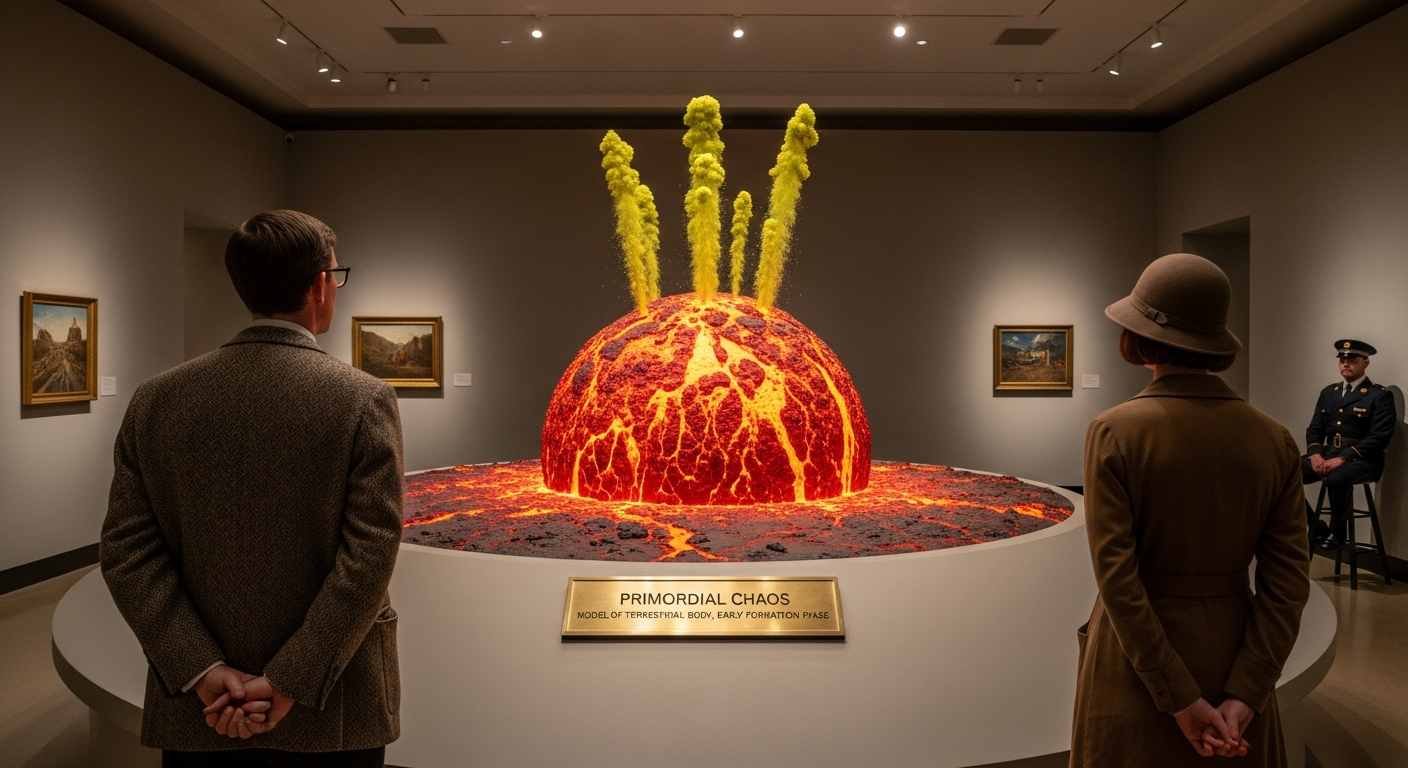
This Planet Has A Permanent Lava Ocean And It's Been Burping Sulfur The Whole Time
Nature Astronomy · 2026-03-16
Scientists pointed the James Webb Space Telescope — a machine the size of a tennis court that had to fold itself up like origami to fit in a rocket — at a planet called L 98-59 d, which is smaller than Earth and covered in a permanent ocean of molten rock. That magma ocean has been pumping sulfur gas into the planet's atmosphere nonstop. Up in the atmosphere, sunlight hits the sulfur and turns it into sulfur dioxide — the same gas that comes out of volcanoes. The planet also used to be bigger, but it cooled down and leaked atmosphere until it shrank.
The takeaway
A planet-sized lava ocean has been running a sulfur factory this whole time and nobody asked it to stop.
Read the paper ↗
Climate & Earth Sciences
Most People In Europe Have Not Decided How They Feel About Saving The Planet Yet
Nature Climate Change · 2026-03-15
Scientists asked people in 13 countries across Europe whether they supported climate policies — things like rules about cars or heating or how energy gets made. Most people were not fully for it or fully against it. They were somewhere in the middle, agreeing with some things and not others. It turns out those middle people are the ones who actually decide whether climate laws get passed at all.
The takeaway
The future of European climate policy is currently sitting in the hands of people who have not made up their minds.
Read the paper ↗
Climate & Earth Sciences
Your Dirt Has Been Quietly Eating Itself — But Only When It's Thirsty
Nature Climate Change · 2026-03-15
Soil stores a massive amount of carbon — basically, the ground is doing a job you never asked it to do, like a Minecraft chest that also affects the weather. Scientists ran a ten-year experiment warming up patches of ground and controlling how much rain they got. When the warm ground stayed wet, it stored more carbon. When the warm ground got dry, it lost carbon instead — the tiny microbes living in the soil, which are like the workers running the whole operation, behaved completely differently depending on how thirsty they were. The amount of rain, it turns out, is the whole deciding vote.
The takeaway
Your local dirt is either storing the planet's carbon or releasing it, and it depends entirely on whether it rained last Tuesday.
Read the paper ↗
Chemistry
Biochemistry

Scientists Found a Way to Make One Microbe Beat Up Another Using Its Own Lunch
Biorxiv · 2026-03-23
Bacteria need iron to survive, and some of them are very good at stealing it. A microbe called Bacillus amyloliquefaciens makes special grabbing molecules — called siderophores — that snatch iron out of the environment before other bacteria can get to it. Scientists figured out exactly which ingredients B. amyloliquefaciens uses to build those grabbing molecules, then checked whether its enemy, Ralstonia solanacearum — a bacteria that kills plants — uses the same ingredients. It does not. So when the scientists added extra of those ingredients to B. amyloliquefaciens, it made more grabbing molecules and got even better at beating R. solanacearum in a fight.
The takeaway
Your lunch being different from your enemy's lunch is, apparently, a valid military strategy.
Read the paper ↗
Chemistry
Your Fridge's Old Gas Has Been Sitting There Waiting To Become Something Else
Nature Chemistry · 2026-03-15
Some chemicals used in fridges and air conditioners — called hydrofluorocarbons — are bad for the environment and tricky to get rid of. Scientists have now found a way to break them down using a base, which is a type of chemical that is basically the opposite of an acid, the way baking soda is the opposite of lemon juice. When the hydrofluorocarbon breaks apart, it releases fluorine — one of its main ingredients — and that fluorine gets caught and turned into potassium fluoride, a completely different and useful chemical. That potassium fluoride can then be used to build new things, including both organic compounds — stuff that contains carbon, like most things inside you — and inorganic compounds, which is everything else.
The takeaway
Your fridge gas can be disassembled like a Minecraft crafting table and turned into entirely different chemicals.
Read the paper ↗
Chemistry
Scientists Taught A Computer To Predict When Proteins Clump Up And Ruin Everything
Nature Chemistry · 2026-03-21
When scientists try to build peptides — which are like tiny protein chains your body uses for basically everything — the pieces sometimes get sticky and clump together before the chain is finished. This is called aggregation, and it is the equivalent of your Minecraft build collapsing because one block decided to be weird. Researchers fed a machine learning model — a computer that finds patterns in giant piles of data — information about thousands of peptide builds that went wrong, and it figured out which specific amino acids (the individual blocks in the chain) are the ones causing all the problems. Now the model can look at a peptide recipe and tell chemists in advance: this one is going to clump, use a different route.
The takeaway
Your body's building blocks have been quietly causing chaos in laboratories this whole time, and it took a computer to catch them.
Read the paper ↗
Astronomy & Astrophysics
Two Star Clusters Have Been Growing In A Cloud Nobody Was Watching
Nature Astronomy · 2026-03-15
Way out past the edge of the Milky Way, there is a giant cloud of gas floating around called Complex H. Scientists found two clusters of stars inside it — groups of stars that formed together, in the same cloud, at roughly the same time, without anyone's permission. This type of cloud, called a high-velocity cloud, is part of the stuff that floats around galaxies in the space between things. Nobody expected stars to be building themselves out there. They were doing it anyway.
The takeaway
The galaxy has been growing extra stars in the storage clouds this whole time.
Read the paper ↗
Astronomy & Astrophysics

Planets Stuck Between Earth And Neptune Refused To Follow The Rules
Nature Astronomy · 2026-03-15
There is a type of planet that is bigger than Earth but smaller than Neptune. Scientists call them sub-Neptunes. For a while, researchers figured these planets probably all formed roughly the same way — same story, different planet. Then they pointed a telescope at several of them and checked what their atmospheres were made of. Every single one was different. Not a little different. Strikingly different — like if you opened five identical lunchboxes and one had pizza, one had soup, one had rocks, and nobody could explain any of it.
The takeaway
There is an entire category of planet that has been doing its own thing this whole time and nobody knew.
Read the paper ↗
Climate & Earth Sciences
Your Leftovers Are Cooking The Planet And It's Mostly On Purpose
Nature Climate Change · 2026-03-21
Every year, a huge amount of food gets thrown away before anyone eats it. Scientists wanted to know why — was it broken equipment, not enough money, or just people making bad calls? They ran the numbers on food waste around the whole world and found that the main reason food ends up in the bin is misbehaviour — which is the science word for "people just doing the wrong thing." Not broken fridges. Not crop failures. People.
The takeaway
Your leftovers have been heating up the planet, and the equipment was fine the whole time.
Read the paper ↗
Climate & Earth Sciences
Dry Dirt Is Leaking Carbon And It Has Been The Whole Time
Nature Climate Change · 2026-03-15
The ground under your feet is full of carbon — more than all the world's plants and trees put together. Scientists already knew that warming temperatures cause soil to lose some of that carbon into the air. But a new study found that drought makes it worse: when the soil dries out, it leaks even more carbon than it would from heat alone. It is like your lunchbox losing heat faster with the lid off — except the lunchbox is the entire planet and the lid is rain.
The takeaway
The dirt gets worse at its job when it is dry and warm at the same time.
Read the paper ↗
Climate & Earth Sciences
Countries That Trade Together Are Accidentally Fixing The Planet's Homework
Nature Climate Change · 2026-03-17
When countries make trade deals — basically agreeing to buy and sell stuff from each other — they also end up sharing the technology they use to make that stuff. Scientists found that this technology sharing leads to lower emissions, because cleaner machines spread from one country to another through the deals. The problem right now is that not every country has access to the good equipment, so the countries that do have it are kind of doing most of the heavy lifting. Researchers ran simulations — like a very serious version of a Minecraft world where you test things before you try them for real — to figure out how much this actually matters for the climate.
The takeaway
The countries with the best clean tech have been accidentally exporting the planet's homework answers this whole time.
Read the paper ↗
Neuroscience
Your Brain Started Sending Chemical Texts Before It Was Even A Brain
Journal of Neuroscience · 2026-03-21
Before you had a brain, you had a flat sheet of cells that needed to fold itself into a tube — and if that folding goes wrong, it causes serious birth defects. Scientists studying frog embryos found that those cells were already releasing glutamate — a chemical your brain uses to send messages — while the folding was happening. That chemical signal triggered a chain reaction that told the cells to stop multiplying and get on with becoming a tube. When scientists blocked the signal, the tube didn't form correctly and the cells just kept copying themselves like a Minecraft world that won't stop generating chunks.
The takeaway
Your brain was sending chemical messages to itself before it had the equipment to send chemical messages.
Read the paper ↗
Neuroscience
Your Hand Freezes For A Split Second Every Time Something Weird Happens
Journal of Neuroscience · 2026-03-21
When something unexpected appears on screen — even something totally useless, like a random flash of light — your hand stops. Not because you decided to stop it. Your brain hits pause on whatever your hand was doing, figures out if the new thing matters, and only then lets your hand keep moving. Scientists confirmed this by having people tap targets on a screen and then randomly flashing lights or moving the targets without warning. The freeze happened every time, whether the change was important or not. The update to where your hand was going was already finished by the time your brain let it move again.
The takeaway
Your hand has been waiting for your brain's permission this whole time and you never knew.
Read the paper ↗
Biology
Microbiology
Your Plant Has Been Secretly Ordering Antifungal Weapons From The Dirt This Whole Time
Biorxiv · 2026-03-19
When a certain type of root bacteria — called Streptomyces sp. PG2 — moves into a plant, the plant sends it signals. The bacteria receives those signals and starts producing a chemical called DHP, which kills fungus. Before the bacteria was living in the plant, it was barely making any DHP at all. The plant essentially turned on a weapon that was sitting in the bacteria's DNA the whole time, doing nothing.
The takeaway
Your houseplant has been running a chemical weapons program in its roots without mentioning it.
Read the paper ↗
Biology
Your Brain Builds a Whole New Cheat Sheet Every Time You Learn Something
eLife · 2026-03-18
Scientists watched the brains of mice learning a maze for eight weeks straight — the kind where you have to sniff a smell and then remember which hallway has the food. At first, almost none of the brain cells in the front part of the mice's brains were doing anything useful. Then, once the mice got good at the maze, a huge chunk of brain cells suddenly switched on and started tracking exactly where the reward was. The brain did not use old maps it already had. It built brand new ones from scratch. Scientists also found that the brain replays little bursts of activity right after the mouse gets its reward — like a save point in Minecraft — but those replays were completely absent during sleep, which is when everyone assumed they happened.
The takeaway
Your brain waits until you are actually good at something before it bothers remembering it.
Read the paper ↗
Medicine & Health
Someone's Donated Organ Came With An Unexpected Extra Thing Inside It
NEJM · 2026-03-26
When you get an organ transplant, the doctors are trying to give you a working kidney or liver. They are not trying to give you a brain virus. Doctors have now reported a case where Japanese Encephalitis Virus — a virus that attacks the brain — appears to have traveled from a donor organ into the person who received it. The virus was already inside the organ before it arrived. The recipient did not sign up for this.
The takeaway
Organ donation saves lives, and apparently sometimes includes bonus contents that were not listed.
Read the paper ↗
Medicine & Health
Scientists Built A Robot Doctor That Turns Out Did Not Help
Nature Medicine · 2026-03-25
Doctors in the UK tried using an AI — a computer program trained to look at chest X-rays — to jump important scans to the front of the line faster than a normal doctor could. The idea was that the AI would spot problems sooner and get sick people to the next test quicker. After a big official trial with a lot of real patients, the AI-powered line-skipping got people to their next scan in almost exactly the same amount of time as just doing it the normal way. Your chest X-ray waited roughly the same amount of time either way.
The takeaway
A computer trained on millions of X-rays moved the line at the same speed as no computer at all.
Read the paper ↗
Medicine & Health
Doctors Spent Years Arguing About Which Sleeping Potion Works Best For Putting A Tube Down Someone's Throat
NEJM · 2026-04-29
When someone in a hospital needs a tube put down their throat to help them breathe — which, yes, is a real thing doctors do — the doctors first give them medicine to make them unconscious so they do not notice. Two of these medicines are called ketamine and etomidate. Scientists ran a proper experiment to find out which one works better for people who are already very sick. They picked sick adults, gave half of them one drug and half the other, and watched what happened.
The takeaway
Your body has two options for being knocked out before a breathing tube goes in, and doctors needed a randomized controlled trial to pick one.
Read the paper ↗
Medicine & Health
Your Blood Has Been Carrying An Alzheimer's Clue That Works For Other Diseases Too
Nature Medicine · 2026-03-21
There is a protein in your blood called p-tau — phosphorylated tau, which is a normal protein that gets weirdly sticky when something goes wrong — and doctors have been using it to detect Alzheimer's disease for a while now. Scientists ran a study across multiple hospitals and found that the same protein also shows up at higher levels in people with systemic amyloidosis, which is a different disease where proteins clump up in the wrong places around your body. On top of that, the p-tau levels could tell doctors whether a nerve problem called polyneuropathy was caused by amyloidosis specifically, or by something else entirely. One protein. Multiple diseases. Your blood has been holding this information the whole time.
The takeaway
Your blood has been running a multi-disease detection system without filing any paperwork about it.
Read the paper ↗
Physics
Your Glass Is Planning To Break And Has Been Dropping Hints The Whole Time
Nature Physics · 2026-03-15
Scientists found that when glass breaks after being bent or squeezed over and over again, it does not break all at once by surprise. Instead, tiny bits of damage spread through the glass like cracks in ice — slowly connecting until the whole thing gives up. The tricky part is that this pattern actually shows up right at the beginning, in the very first few times the glass is stressed. That means researchers can measure how much energy the glass "leaks" early on and use it to predict exactly when it will finally snap. Your glass has basically been filing a complaint form from the start.
The takeaway
The glass knew it was going to break. It told scientists in round one.
Read the paper ↗
Physics
Scientists Finally Explain Why The Stuff Inside Metal Is Having A Meltdown
Nature Physics · 2026-03-15
Most solid materials — like metal, ice, or rocks — are actually made of tiny crystals all squished together. Where two crystals meet, there is a boundary, and that boundary does not sit still. It moves, and everything near it — individual particles, tiny defects called dislocations — gets dragged along in complicated ways that nobody had a good explanation for. Scientists have now built a framework, basically a set of rules, that predicts exactly how all of that moving and shoving happens. The rules turn out to come from geometry — the same branch of maths where triangles live — applied to a flat, 2D version of the material made from colloids, which are tiny particles floating in liquid.
The takeaway
The inside of solid metal has been doing geometry homework without you the entire time.
Read the paper ↗
Physics
Scientists Build A Memory Stick That Doesn't Know Which Answer It's Giving You
Nature Physics · 2026-03-16
Normal computer memory is like a row of lockers: you pick a number, you open that locker, you get the thing inside. Scientists have now built a quantum version where you can ask for locker 3 *and* locker 7 *at the same time*, and the memory gives you both answers simultaneously, stacked on top of each other, until you actually look. This is called superposition — where something is in two states at once, the way you are both "doing your homework" and "not doing your homework" until your parents walk in. The new design uses a bucket-brigade system, meaning the address gets passed down a chain of quantum switches, like a game of telephone, except the telephone is also in two places at once.
The takeaway
Your computer's memory picks one answer. This one picks all of them and waits for you to decide.
Read the paper ↗
Physics
Your Pencil Does This Too, But Scientists Found It Inside A Three-Layer Piece Of Carbon
Nature Physics · 2026-03-16
Graphene is what you get when you take graphite — the stuff in your pencil — and slice it down to a single layer of atoms. Scientists took three of those layers, twisted them against each other at a very specific angle, and then measured how electricity moved through the whole stack while slowly rotating it. What they found is that three completely different weird things — superconductivity (electricity flowing with zero resistance, like a hallway with no friction), strange metallicity (electricity behaving in a way that breaks the normal rules), and nematicity (the material acting differently depending on which direction you measure it, like a carpet that's easy to slide along one way but not the other) — are all happening at the same time, and they are connected. The angle of the twist is the reason all three showed up together.
The takeaway
A pencil shaving, twisted at the right angle, turns into something that breaks three rules of physics simultaneously.
Read the paper ↗
Chemistry
Biochemistry
Your Body Has A Bacteria Inside It That Steals Snacks Using A Four-Part Team
Biorxiv · 2026-03-18
There is a germ called Mycobacterium tuberculosis — the one that causes TB, a disease that kills over a million people a year — and it has a very specific strategy for staying alive inside you: it steals fat from your own cells and eats it. To do this, it uses a set of proteins called Mce complexes, which work like a delivery system for smuggling lipids — basically biological fats — out of your body and into the bacteria. Scientists just figured out that four proteins called Mam1A, 1B, 1C, and 1D have to work together as a team, along with a coordinator protein called LucA, to keep the whole operation running. Without the team assembled correctly — including two specific chemical locks called disulfide bridges holding Mam1A together — the whole smuggling ring falls apart.
The takeaway
A bacterium has been running a four-member fat-theft crew inside human lungs for a very long time.
Read the paper ↗
Neuroscience
Your Body Has A Poison That Also Secretly Fights Cancer, Scientists Report
Neuron · 2026-07-12
Scientists gave mice a chemical called 6-OHDA — a poison that destroys nerve endings — and the tumors started shrinking. That part was already known. The new part is why: the 6-OHDA was making cancer cells send out a distress signal called IFN-β, which is basically a flare gun that summons a specific type of immune cell called an ISG+ macrophage — a macrophage being one of the white blood cells your body uses as a cleanup crew. Those macrophages then switched on a mode called TH1 tumor suppression, which is your immune system's version of deciding, actually, the tumor has to go. The scientists confirmed this in mice with breast tumors, using a chemical that everyone thought was only interesting because it broke nerves.
The takeaway
A nerve poison accidentally taught the immune system to do its job better, and nobody asked the mice if that was okay.
Read the paper ↗
Neuroscience
Your Brain's Anxiety Setting Has Been Secretly Managed By The Wrong Cells This Whole Time
Neuron · 2026-07-12
You know that feeling when you walk into a test you forgot about and your whole body goes into emergency mode? Scientists wanted to know where that starts in the brain. They found that astrocytes — the cells your brain uses basically as janitors, not the main thinking cells — are actually the ones tracking whether you're anxious. The janitors have been running the anxiety department. In a part of the brain called the basolateral amygdala, these astrocytes light up during scary or stressful situations, and when scientists messed with their signals, the anxiety behavior changed too. The janitors are not just cleaning up. They are in charge.
The takeaway
Your brain assigned anxiety management to the maintenance crew, and they have been on the job since birth.
Read the paper ↗
Biology
Scientists Built A Tiny Spring To Find Out How Hard Your Brain's Delivery Trucks Push
eLife · 2026-03-25
Inside your neurons — the long, skinny cells that run from your brain all the way down your spine — there are tiny motor proteins called KIF1A that work like delivery trucks, hauling cargo from one end of the cell to the other. Scientists wanted to know exactly how hard these trucks push before they give up and stop, which is called the stall force. The problem is that KIF1A falls off its track the moment you push on it from the wrong direction, which made measuring it almost impossible with the usual equipment. So researchers built a DNA origami nanospring — a microscopic spring made entirely out of DNA — that pushes on the truck from the correct direction and measures the force by watching how far the spring stretches.
The takeaway
Your brain's delivery trucks have a specific push limit, and it took a spring made of DNA to find out what it is.
Read the paper ↗
Neuroscience
Systems Neuroscience
Your Brain's Chill Setting Goes Up When You Chew Nicotine Gum, But That's Not Why It Hurts Less
Biorxiv · 2026-03-19
Scientists gave 62 adults either nicotine gum or fake gum and then made them sit through heat and pressure pain tests while wearing an EEG — a helmet-looking thing that reads your brain's electrical activity. The nicotine gum did two things: it turned down how much the heat hurt, and it bumped up something called peak alpha frequency, which is basically how fast your brain hums at rest, like a fan switching from low speed to medium. Here is the part that scientists did not expect: the brain-humming-faster part and the pain-hurting-less part turned out to have nothing to do with each other. They both happened. At the same time. In the same people. For apparently unrelated reasons.
The takeaway
Your brain quietly changed two settings at once and neither one caused the other.
Read the paper ↗
Medicine & Health
Scientists Spent Two Years Getting People To Drink More Water And The Stones Came Back Anyway
The Lancet · 2026-03-21
Your kidneys can make stones — actual little rocks — inside your body, and drinking more water is supposed to stop them coming back. Scientists ran a whole programme to help people drink more water and checked in for two years to see if it worked. The people in the programme did produce more pee — which is the goal — but the stones came back at the same rate anyway. Your kidneys made the rocks on schedule regardless.
The takeaway
Your kidneys will build rocks inside you on their own timeline and they are not taking requests.
Read the paper ↗
Medicine & Health

Scientists Teach One Sniff To Fight Every Germ At Once
Nature Medicine · 2026-03-17
Researchers gave mice a vaccine through their nose — no needle, no shot, just a sniff — and it protected them against a wide range of bacteria and viruses that attack the lungs. Normally a vaccine only works against one specific germ, like a hall pass that only gets you into one classroom. This one appeared to work across many germs at the same time. The mice are fine. The scientists are now looking at whether this works in humans.
The takeaway
Your nose has been a perfectly good entry point for medicine this whole time and nobody used it until now.
Read the paper ↗
Chemistry
Biochemistry

Your Cells Have A Shredder, And Some Proteins Figured Out How To Unplug It
Biorxiv · 2026-03-19
Your cells have a shredder. It is called the proteasome, and its whole job is to grab proteins tagged for deletion and destroy them. Scientists want to use this shredder as a weapon — building special molecules that drag a problem protein to the shredder and get rid of it. The problem is that one family of proteins, called DUBs — deubiquitylases, which are basically the cell's untag department — can rip the deletion tag off themselves before the shredder even notices. Scientists tested all of them and found that some DUBs get shredded just fine, some tear off their own tags to escape, and some just stand in front of the shredder doing nothing and it still doesn't work.
The takeaway
Some proteins have figured out how to undo their own death sentence, and your cells let them.
Read the paper ↗
Astronomy & Astrophysics
Scientists Pick a Moon Spot to Land On Without Actually Going There Yet
Nature Astronomy · 2026-03-15
There is a place on the Moon called Rimae Bode, and scientists have decided it would be a good place to land a crewed mission — by looking at it from space. Using orbital mapping, which is basically staring at something very hard from very far away, researchers identified four different types of terrain in the region. Some of it is from old volcanoes. Some of it is from things crashing into the Moon. Scientists believe that if you went there and picked up rocks, you could learn things about how the Moon's surface and insides formed billions of years ago. Nobody has touched any of it yet.
The takeaway
Humans have selected a Moon landing spot using only the method of looking at it from space.
Read the paper ↗
Climate & Earth Sciences
Your Government Has Been Running Two Climate Rules That Cancel Each Other Out
Nature Climate Change · 2026-03-15
Scientists looked at climate policies — the rules governments make to stop the planet from overheating — across countries all over the world. What they found is that sometimes two policies work together like a team, and sometimes they crash into each other like two kids going for the same ball at recess. The problem is that nobody has been keeping track of which is which. Your country might be running rules right now that are quietly undoing each other, and until this study, that was not something anyone had checked in a serious, global, on-purpose way.
The takeaway
Governments have been stacking climate rules on top of each other without checking if they get along.
Read the paper ↗
Climate & Earth Sciences
The Rules For Fixing Climate Change Keep Breaking Each Other
Nature Climate Change · 2026-03-15
Governments have a rule called carbon pricing, where you pay extra money if you burn stuff that heats up the planet. Scientists ran a global check and found that this rule works differently depending on what other climate rules are running at the same time — sometimes the rules help each other, and sometimes they get in each other's way, like two kids both trying to carry the same lunch tray. The researchers say that if you pick the wrong combination of rules, you end up spending more to fix less. The right combination, though, gets you more planet-cooling per dollar.
The takeaway
Governments have been running climate rules at the same time without checking if they are fighting each other.
Read the paper ↗
Climate & Earth Sciences
Your EV Battery Is Slowly Losing A Fight With The Weather
Nature Climate Change · 2026-03-16
Scientists ran simulations — giant computer models that pretend to be the real world — for 300 cities across the planet to find out what climate change does to electric car batteries. The answer is: it shortens how long they last. Older batteries, the ones built between 2010 and 2018, are predicted to lose about 8% of their lifetime because of it. Batteries built after 2019 only lose about 3%, because the newer ones are tougher and handle heat and cold better than the old ones did.
The takeaway
Your car battery is slowly losing a fight with the sky, but it is losing that fight less badly than it used to.
Read the paper ↗
Neuroscience
Scientists Built An AI To Figure Out Why Your Brain Sometimes Just... Stops
Nature Neuroscience · 2026-03-25
Your brain is supposed to be conscious — awake, aware, running the whole operation — but sometimes it isn't, and doctors have not always known why. Researchers built an AI and made it fight against itself, over and over, until it started figuring out what actually turns consciousness off. The AI found new reasons the brain can go dark, and then pointed at a specific part deep inside your brain — called the subthalamic nucleus, which is basically a tiny control room you have never thought about — as a possible place to fix it. Scientists have not used this on patients yet, but the AI says it should work.
The takeaway
There is a room deep in your brain that runs the lights, and nobody told you about it until now.
Read the paper ↗
Neuroscience
Systems Neuroscience
Your Eyes Have Been Scrambling Letters The Whole Time And Nobody Told You
Biorxiv · 2026-03-25
When your eyes send a picture to your brain, the signal has to travel through several checkpoints before you actually see anything. Scientists discovered that tiny mix-ups — called "spatial scrambling" — can happen at these checkpoints, and the mix-ups shuffle the position information in the image like someone dropped your homework and put the pages back in the wrong order. They tested two types of shuffling: one that happens before your brain's main letter-reading cells kick in, and one that happens after. When humans tried to read scrambled letters, the two types of scrambling made the letters look different kinds of broken — and messed up reading in different ways. It turns out your brain is much better at handling scrambling that makes letters blurry and repeated than scrambling that makes them look like pure static.
The takeaway
Your brain has a preferred flavor of broken, and it has been quietly compensating for it your entire life.
Read the paper ↗
Biology
Systems Biology
Scientists Built a Robot Referee for When Biology Notes Disagree With Each Other
Biorxiv · 2026-03-25
Scientists have spent years writing down every time one molecule talks to another molecule inside your body. The problem is that different scientists write down different things, and nobody has been checking if they match. A new tool called VIOLIN — which stands for something very long — reads through all those notes and sorts each one into a pile: "yep, same thing," "wait, these contradict each other," "weird, flag this," or "new information, never seen before." They tested it using four different reading systems, including two AI chatbots, and VIOLIN gave back the same organized piles every time.
The takeaway
Your cells have been having arguments in the scientific literature for decades and nobody sorted them out until now.
Read the paper ↗
Biology
Evolutionary Biology
Scientists Discover That Putting Things In The Wrong Order Gives The Wrong Answer
Biorxiv · 2026-03-18
When scientists study how two traits evolved together across a family tree of bacteria, they have to pick which one goes first in the equation — like deciding who's Player 1 and who's Player 2. Researchers ran 16,000 simulations and found that if you pick the wrong one, you can get a completely different conclusion. To figure out which trait should go first, they tested seven different methods for choosing. Three of them — all measuring something called phylogenetic signal, which is basically how much a trait follows the family tree — worked the best. The other four, including some methods scientists use all the time, were less reliable.
The takeaway
The order you put things into the equation matters, and your gut feeling about which one goes first is not a valid scientific method.
Read the paper ↗
Medicine & Health
Doctors Discover That Doing Several Things At Once Helps Sick Moms Get Better
NEJM · 2026-03-17
Scientists at a very serious medical journal found that when doctors try more than one thing at a time to treat infections in pregnant people and new moms, the patients do better than before. This is called a "multicomponent intervention," which means exactly what it sounds like: multiple components, intervening. The researchers wrote this up and sent it to the New England Journal of Medicine, which is one of the most important medical journals in the world, and it is now being published.
The takeaway
Doing several helpful things at once turns out to be more helpful than doing fewer helpful things.
Read the paper ↗
Medicine & Health
Scientists Test New Drug On Two Cancers At The Same Time Because Why Not
NEJM · 2026-04-12
Researchers ran a clinical trial — a test on real patients — for a drug called setidegrasib. The drug was given to people with two different types of cancer: one in the lungs and one in the pancreas, which is an organ near your stomach that helps digest food. Scientists collected results from both groups to see how the drug performed. The trial was published in the New England Journal of Medicine, which is a very serious medical journal that adults read with very serious faces.
The takeaway
Your body can grow a problem that takes a clinical trial and a name nobody can pronounce to deal with.
Read the paper ↗