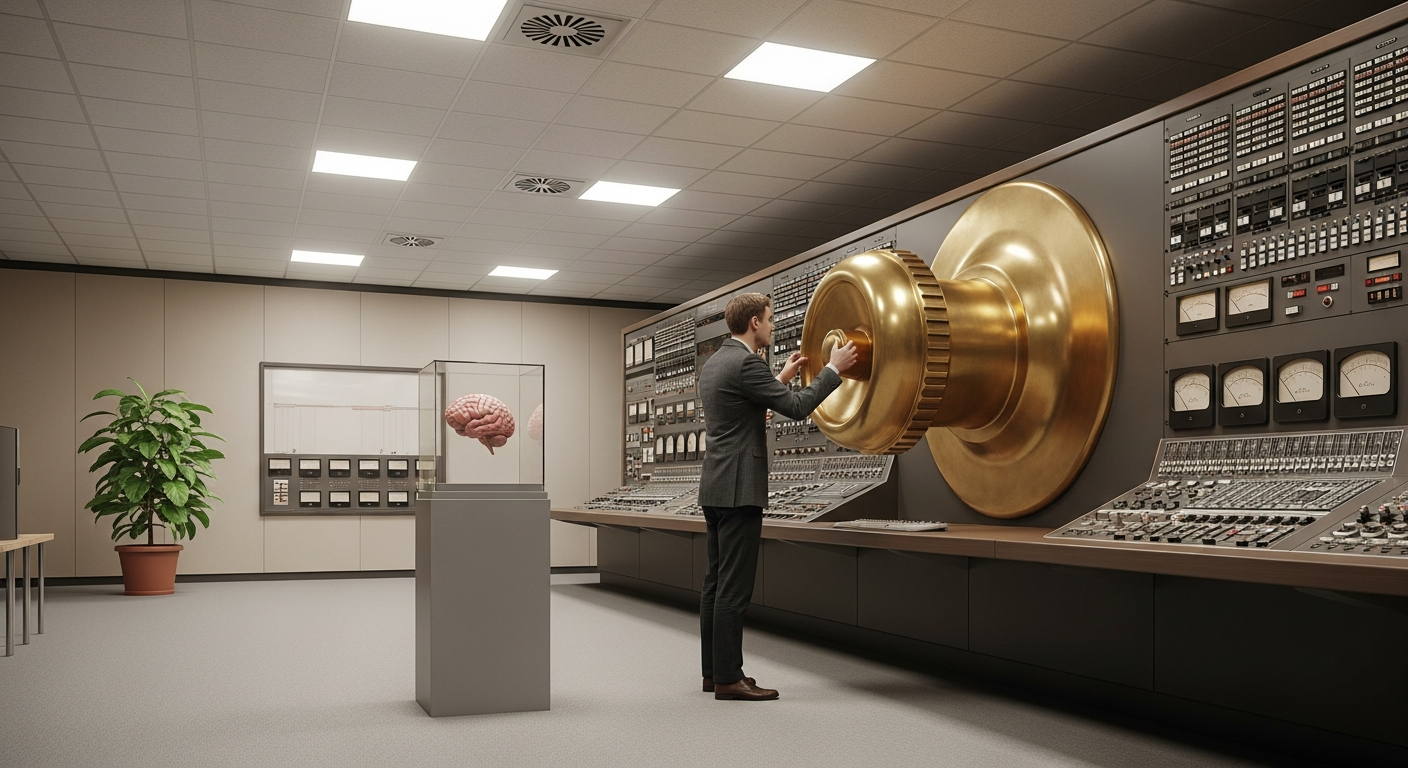
Your Brain's Overactive Alarm System Has a Volume Knob, Scientists Report
Journal of Neuroscience · 2026-03-21
Researchers studying drug-resistant epilepsy — the kind where standard medications have already failed — injected a molecule called Ant-134 directly into the brains of mice whose neurons had been stuck in a pattern of misfiring since a seizure-inducing event earlier in their lives. Within days, the neurons in a key memory region of the brain were measurably calmer: firing less chaotically when provoked, receiving fewer excitatory signals from neighboring cells, and responding more quietly to stimulation from connected brain circuits. The treatment works by blocking a tiny piece of genetic material called microRNA-134, which normally acts like a dial that keeps dozens of proteins turned down. Turn off the dial-turner, and the overexcited brain, it turns out, starts to settle.
Takeaway
The epileptic brain, it turns out, can be talked down — at least in mice, and at least when you inject something directly into it.
Your Brain Is Already Doing the Math on Whether to Scoot Closer
Nature Neuroscience · 2026-03-21
Researchers studying mice in the cold have found that the prefrontal cortex — the part of the brain responsible for planning and decision-making — is directly involved in the choice to huddle with others for warmth. When scientists used light to silence that region in some mice, their groupmates didn't just notice: they physically compensated, closing the gap themselves. The group, in other words, self-corrected. What looked like a simple pile of cold mice turns out to be a coordinated social negotiation, managed at the level of individual brains talking to each other through behavior.
Takeaway
The decision to press yourself against another warm body, it turns out, is a considered one.
Your Brain's Filing System Worked Completely Differently When You Were a Kid
Journal of Neuroscience · 2026-03-21
Researchers scanning the brains of people aged 8 to 25 found that rewards help everyone remember things better — but through entirely different mechanisms depending on age. In adults, the brain stores rewarding memories by locking them in place, keeping the pattern stable from the moment of learning through to recall. In children and teenagers, the opposite is true: their memories actually improved when the brain's pattern drifted and changed over time. The part of the brain responsible for this difference is the anterior hippocampus, a key memory structure, which appears to run on completely different organizational logic before and after adulthood. A separate reward-signaling region, the ventral tegmental area — essentially the brain's "this matters" alarm — was linked to pushing the hippocampus toward that drifting, shifting style of storage.
Takeaway
It turns out the memory strategy your brain eventually settled on as an adult is not the one it used on you as a child.
Your Brain Has Been Running a Four-Alarm Inflammation Response Since Menopause Started
Biorxiv · 2026-03-25
Researchers removed the ovaries from mice and then watched, closely and over months, as the hypothalamus — the part of your brain that manages body temperature, hormones, and a surprising number of things you'd prefer were running smoothly — quietly caught fire. Not literally. But at the molecular level, inflammatory pathways activated, support cells went on high alert, and a cluster of neurons called KNDy cells, which are responsible for triggering hot flashes, showed mounting signs of strain the longer estrogen stayed gone. When scientists compared this slow-building pattern in mice to RNA data from aging human female brains, the two matched well enough to suggest the same process is running in you, on roughly the same timeline, with no obvious off switch.
Takeaway
It turns out the hot flash is just the part of the hypothalamic crisis you can feel.
Your Brain's Construction Crew Was Running On Frog Chemistry The Whole Time
Journal of Neuroscience · 2026-03-21
Before your brain was a brain, it was a flat sheet of cells that had to fold itself into a tube — and apparently, it needed to do this in the first four weeks of pregnancy, before most people even know they're pregnant. New research in frog embryos found that this folding process depends on glutamate, the same chemical your brain uses to send signals, being released in precise bursts by a protein called VGluT1. When researchers blocked that protein in the frogs, the neural tube failed to close properly, producing the kind of birth defects that cause serious, lifelong neurological damage. The cells also stopped developing correctly, piling up in an immature state instead of moving on to become a working nervous system. Because the same signaling machinery exists in humans, the findings raise a preliminary concern that certain common medications taken during early pregnancy could interfere with a process that is already finished before most prenatal care begins.
Takeaway
It turns out your entire nervous system was assembled using the same chemical your neurons still use to talk to each other — and the construction window closed before your mother missed her first appointment.
Your Immune System's Anti-Cancer Crew Was Being Quietly Assembled By A Nerve Poison
Neuron · 2026-07-12
A drug called 6-OHDA has long been used by researchers to destroy nerve fibers — specifically the ones that connect your nervous system to your organs. Scientists assumed that if it slowed tumor growth in mice, it was because cutting those nerve connections starved the tumor of growth signals. It turns out the drug was doing something else entirely: triggering cancer cells to release an alarm signal called IFN-β, which then recruited a specialized squad of immune cells to attack the tumor. Those immune cells, in mice with mammary tumors, appear to coordinate a targeted anti-tumor response — one the nervous system had nothing to do with. The nerve destruction, it seems, was beside the point.
Takeaway
A drug scientists have used for decades to destroy nerves has, it turns out, also been quietly running an anti-cancer immune operation on the side.
Your Hand Already Stopped. Your Brain Is Still Deciding Why.
Journal of Neuroscience · 2026-03-21
When something unexpected happens — a flash on a screen, a target that moves — your hand doesn't wait for your brain to figure out what it means. It just stops. Researchers at a lab studying rapid hand movements found that the moment something salient changes in your environment, your motor system reflexively freezes movement initiation, buying time for your brain to catch up and decide what to do next. The pause lasts only a fraction of a second — in line with standard reaction times — but by the time your hand starts moving again, the new plan is already fully loaded. Crucially, your hand doesn't care whether the change was even relevant to what you were doing: a meaningless flash of light was enough to trigger the same brake. The more visually striking the change, the harder the brake.
Takeaway
Your hand, it turns out, has been quietly overruling you for your own protection this entire time.
The Part of Your Brain Running Your Anxiety Has Been Outsourced to the Support Staff
Neuron · 2026-07-12
Researchers studying the basolateral amygdala — the brain region most associated with fear and anxiety — have found that astrocytes, the cells long considered mere structural support for neurons, are actively tracking and driving anxiety states. Using live calcium imaging in mice across a range of stress-inducing tasks, the team watched astrocytes light up in reliable patterns that matched anxious behavior. When they genetically altered astrocyte calcium signaling — essentially muting the support staff — anxiety behavior changed accordingly. The mechanism runs through noradrenergic signaling, the same stress-chemical pathway that activates when you hear your name said in a tone you don't like.
Takeaway
It turns out your anxiety is not a neuron problem — it is, at least in part, a glial cell problem, which is a sentence nobody was prepared to say.
Your Brain's Pain Settings Have a Nicotine Gum Workaround, For Reasons Nobody Can Explain
Biorxiv · 2026-03-19
A randomised, double-blind trial gave 62 healthy adults either a 4 mg nicotine gum or a placebo, then subjected them to prolonged heat and pressure until they said ouch. The nicotine group reported slightly less heat pain than the placebo group — a small but real difference. Nicotine also nudged a brain-wave pattern called peak alpha frequency, a measure of how fast your brain idles at rest, upward across the scalp, most noticeably toward the centre and right-front of the head. Researchers then checked whether the brain-wave shift was responsible for the pain relief, which would have been a tidy explanation. It was not.
Takeaway
Nicotine gum does, in a preliminary study, turn down the heat-pain dial a little — it just has no interest in telling us how.
Your Brain's On/Off Switch Has Been Located, Per AI That Was Specifically Designed To Pick Fights
Nature Neuroscience · 2026-03-25
Researchers have built an AI framework that works by generating competing hypotheses against itself — essentially arguing until something useful emerges — and pointed it at one of neuroscience's oldest problems: figuring out what actually keeps you conscious. The model identified new potential causes of unconsciousness and flagged a small, deep brain structure called the subthalamic nucleus — about the size of a lentil, located near the base of your brain — as a possible target for treating disorders of consciousness, like coma or vegetative states. The findings come from computer simulations, not clinical trials, so the subthalamic nucleus has not yet been tested in patients. Still, the AI's ability to generate and then immediately dismantle its own theories is, according to the researchers, the point.
Takeaway
It turns out the question of what keeps the lights on in your head required an AI to argue with itself in a simulation to get anywhere useful.
Your Brain Reads Scrambled Letters Better Than Anyone Expected, Which Says Something Unflattering About Your Brain
Biorxiv · 2026-03-25
Researchers studying how your visual system processes information found that the location of the glitch matters more than the glitch itself. When they artificially scrambled signals at two different points along the brain's visual pipeline — one closer to the eye, one deeper in the cortex — the scrambling produced meaningfully different results on your ability to read a letter. The deeper, cortical scramble left orientation information redundant but jumbled in space, and humans handled that surprisingly well. The earlier, subcortical scramble introduced what the researchers call "orientation noise," and that, it turns out, is the one that really trips you up. The finding suggests that the part of your visual cortex responsible for detecting edges and angles — the same machinery you are using right now to read this sentence — is quietly doing more compensatory work than anyone had formally confirmed.
Takeaway
Your visual system, it turns out, is specifically bad at noise and specifically good at mess.
The AI-Driven Diagnostic Acceleration Hypothesis held that artificial intelligence prioritization of chest X-ray worklists would meaningfully shorten the time between imaging and confirmed lung cancer diagnosis. It was adopted with considerable institutional enthusiasm, positioned as a practical bridge between the promise of machine learning and the urgent clinical reality of delayed cancer detection. Radiology departments, health systems, and procurement bodies treated the hypothesis as a reliable foundation for investment in AI triage tooling. Its decline began as randomized evidence, rather than observational data, was brought to bear on the core claim. A large UK-based randomized controlled trial found that AI-driven prioritization did not produce a statistically significant reduction in time to CT or to confirmed lung cancer diagnosis when measured against standard clinical workflow.
Cause of death
Failure to demonstrate a statistically significant reduction in time to CT or lung cancer diagnosis relative to standard workflow in a large UK-based randomized controlled trial.
Survived by
It is survived by AI-assisted clinical decision support, diagnostic workflow optimization research, and a well-funded cohort of health systems mid-implementation whose procurement cycles had not yet concluded.
It directed serious research attention and institutional resource toward the question of whether AI could reduce diagnostic delay in lung cancer, and that question was worth asking.
Note
The bottleneck in lung cancer diagnosis, it appears, was not the order in which images were read.
No tracking. No ads. No cookies. Your email is only used to deliver the newsletter. Theme preference is stored locally in your browser.
Privacy policy →