Ancient Humans Were Eating Elephants on Purpose, Which Honestly Tracks
eLife · 2026-03-18
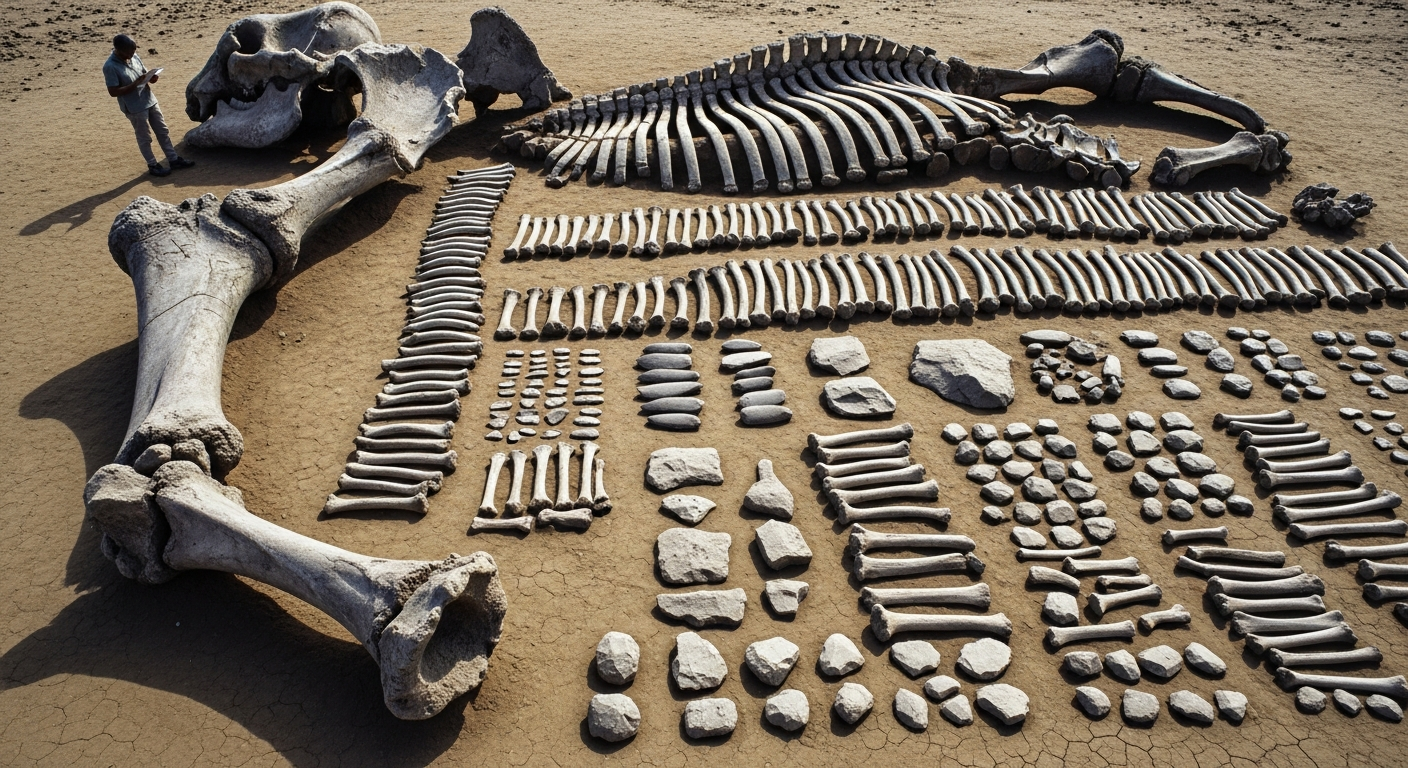
Scientists digging at Olduvai Gorge have found the oldest known evidence of our ancestors deliberately butchering elephants — not stumbling across a dead one and shrugging, but actually having a plan. The bones show deliberate cut marks. There was a whole site for it. Around 1.8 million years ago, early humans looked at the largest land animal on Earth and thought: that's lunch, and I have a strategy. Modern hunter-gatherers, for the record, only pull this off occasionally. Our ancestors were doing it systematically, with no instruction manual, no refrigeration, and tools that were essentially sharp rocks.
Takeaway
Turns out the most ambitious meal-prep operation in history happened 1.8 million years ago, and the recipe was just "elephant, rocks, commitment."
Your Heart Cells Are Literally Falling Apart, And Then They Call The Cops On Themselves
Biorxiv · 2026-03-25
A certain heart gene mutation causes the membrane around your heart cells' nuclei to burst open. That's bad enough. But here's the twist: when the nucleus ruptures, loose DNA spills into the cell — and the cell, seeing stray DNA floating around where it absolutely should not be, does the only logical thing. It panics. It calls the immune system. It tells the fibroblasts. It starts a whole neighborhood watch program. The resulting inflammation and scarring is, it turns out, what actually kills you. The heart isn't failing because the cells broke. The heart is failing because the cells reported themselves to the authorities.
Takeaway
The cure for a heart that's snitching on itself may be to cut the phone line — and apparently, that works.
Scientists Sent Bacteria Into a Tumor to Start a Fight
Nature Biotechnology · 2026-03-21
Normally, finding E. coli somewhere in your body is the problem. In this case, researchers engineered it to be the solution. Scientists redesigned the bacteria to pump out nitric oxide directly inside solid tumors — softening them up, remodeling the neighborhood, and making them suddenly very cooperative with immunotherapy. The tumor, which had been ignoring the immune system's calls, now has to pick up the phone.
Takeaway
Science has officially outsourced cancer treatment to bacteria, and honestly, the bacteria seem more motivated.
The Brain Regions Keeping You Awake Have Never Heard of the Brain Regions Keeping You Awake
PLOS Biology · 2026-03-19
For decades, science had a tidy story: a handful of well-known brain regions fire up, you wake up, everyone goes home. Turns out the brain did not get that memo. Researchers mapped exactly which neurons light up when mice are kept awake by drugs versus just, you know, being awake — and the two methods use almost completely different circuitry. The famous "wake centers" that textbooks swear by? Barely showed up. Meanwhile, a parade of obscure brain structures that nobody invited — including something called the area postrema, which is mostly famous for making you vomit — were the ones actually doing the heavy lifting, at least when the drug solriamfetol was involved. The brain, it turns out, has a whole backup cast for staying conscious, and it has been running the show this entire time.
Takeaway
The neuroscience of wakefulness is essentially a heist movie where the famous suspects have alibis and the real culprits are nine guys nobody has ever heard of.
Scientists Photograph Every Tiny Synapse in a Fly Brain and the Fly Had No Say in This
eLife · 2026-03-18
Deep inside the fruit fly brain lives a structure called the mushroom body, which handles learning and memory. Scientists have now mapped its synapses in obsessive detail — individual protein scaffolds, their exact positions, how they cluster, how they vary fly to fly, and how they physically rearrange after the fly learns something. The technique involves splitting a glowing protein in half and making the two halves find each other only at specific synapses, which is either elegant or unsettling depending on your relationship with fruit flies. The upshot: every fly brain is slightly different, but in a very organized way, and a single learning experience visibly reshapes the architecture of the synapses involved.
Takeaway
Flies are out here having their neurons remodeled by experience and we still forget where we put our keys.
The Virus That Punches Through Walls Has a Very Complicated Elbow
Biorxiv · 2026-03-19
Scientists have mapped exactly how a bacteria-killing virus throws its punch. Phage 812 lands on a bacterial cell, its little receptor arms wiggle, and that wiggle — through a Rube Goldberg chain of proteins with names like "weld proteins" and "tripod complexes" — eventually causes the virus's tail to violently contract, driving a tube 10 to 30 nanometers through the cell wall like a hypodermic needle fired by a very small cannon. The tail literally shrinks to half its length just to generate the force. Nature built a spring-loaded syringe and hid it inside something smaller than your eye can see.
Takeaway
The virus does not knock. It remodels the entryway.
Scientists Made a Gene Editor Worse On Purpose and It Got Better
Nature Biotechnology · 2026-03-21
Researchers have discovered that the secret to a more precise gene-editing tool was to take the existing tool and undo some of the improvements they'd already made to it. The technique, called mutation reversion analysis, works by walking a highly evolved protein backwards down its own upgrade history until it stops hitting things it wasn't supposed to hit. Science has officially confirmed that sometimes the best move is to ask your software to restore a previous version.
Takeaway
Evolution, it turns out, overshoots — and the fix for a too-clever gene editor is a firm "undo."
Scientists Ran 28 Spreadsheets Through a Computer and Found 64 Drugs That Were Already Approved
Biorxiv · 2026-03-20
Tuberculosis kills over a million people a year and is getting harder to treat as it builds resistance to antibiotics. So researchers did the next logical thing: they fed 28 different TB gene expression datasets into a computational blender, hit go, and asked the computer which already-approved drugs technically look like they should work. The answer was 64 of them. Cholesterol drugs. Tamoxifen. Statins. Drugs your cardiologist already prescribes. The TB was apparently sitting there the whole time, genetically compatible with half the pharmacy aisle.
Takeaway
TB has been killing people for millennia and the solution may have been in the drug cabinet the whole time — we just needed enough spreadsheets to notice.
Science Discovers That Putting Things in the Wrong Order Gives You the Wrong Answer
Biorxiv · 2026-03-18
Researchers studying bacterial evolution noticed something unsettling: in a widely used statistical method, swapping which variable goes on which side of the equation could flip your conclusions entirely. Not sometimes. In a substantial proportion of cases. They ran 16,000 simulations to confirm this, which is the scientific equivalent of checking that the stove is off seventeen thousand times. The good news is they found a fix. The bad news is the fix involves something called Blomberg's K, which sounds like a discount furniture store but is apparently the most reliable thing in the room.
Takeaway
Science has confirmed that variable placement matters, and the thing most scientists use to pick it is the wrong thing.
Scientists Discover That Plants, Like Everyone Else, Benefit From Meeting Someone New
Biorxiv · 2026-05-24
Researchers took a rare prairie wildflower that had been quietly struggling in three small, isolated patches and did something radical: they introduced the plants to each other. The result was a 281% boost in fitness for one population — meaning the offspring of cross-population plants didn't just survive, they absolutely thrived. The takeaway from years of careful fieldwork is essentially that this flower's problem was that it had been hanging out with its cousins for too long.
Takeaway
Science has confirmed that for endangered prairie plants, the best conservation strategy is a long-distance relationship.
Phylogenetic Generalised Least Squares As A Robust Causal Inference Method, 1990s – 2024
Phylogenetic Generalised Least Squares regression proposed that evolutionary associations between traits could be estimated reliably across species while accounting for shared ancestry, offering comparative biologists a principled and statistically defensible framework for their analyses. It was widely adopted across ecology and evolutionary biology, becoming a standard tool in the assessment of trait coevolution and the construction of adaptive hypotheses. For several decades it occupied a position of considerable methodological authority, appearing in thousands of comparative studies and forming the backbone of graduate training in the field. Its decline began as researchers examined the sensitivity of the method's conclusions to the assignment of variables to the dependent and independent positions — a choice that, in a genuinely robust method, ought not to determine the outcome. The terminal finding demonstrated that reversing the dependent and independent variables in a substantial proportion of published PGLS analyses yielded inconsistent or contradictory conclusions, revealing that the method had been bearing a causal interpretive weight it was not constructed to support.
Cause of death
Demonstrated asymmetry of results under variable reversal across a substantial proportion of cases, establishing that the method's conclusions were sensitive to an analytical choice that causal inference requires to be inconsequential.
Survived by
It is survived by phylogenetic comparative methods more broadly, the emerging framework of causal inference in evolutionary biology, alternative regression approaches less susceptible to directional sensitivity, and a considerable body of published literature whose conclusions are now under quiet reassessment.
It brought statistical rigour to the comparison of traits across species at a time when the alternative was largely informal, and the questions it helped researchers ask remain among the most important in evolutionary biology.
Note
The associations PGLS identified were real enough; the causal directions it appeared to endorse were a different matter entirely.
No tracking. No ads. No cookies. Your email is only used to deliver the newsletter. Theme preference is stored locally in your browser.
Privacy policy →