Your Brain Sent a Construction Memo Before You Were Born, and It Was Written in Neurotransmitter
Journal of Neuroscience · 2026-03-21
Before your brain was a brain, it was a flat sheet of cells that had to fold itself into a tube — and apparently, it needed to use the same chemical your neurons still use to talk to each other. Scientists studying frog embryos discovered that glutamate, the brain's main "go" signal, is already being fired off during this early folding process, weeks before there is anything resembling a brain to receive it. When they blocked this signal, the tube didn't close properly. The cells just kept multiplying instead, apparently having missed the memo that it was time to roll up and become a spine.
Takeaway
The brain bootstraps itself into existence using the very system it is still building — which is either deeply elegant or a sign that biology has no project manager.
Your Brain Has a Button Labeled "Go Cuddle Someone, It's Cold"
Nature Neuroscience · 2026-03-21
Scientists have located the part of the mouse brain that decides whether to huddle with friends when the temperature drops. It's in the prefrontal cortex — the same region responsible for planning, judgment, and, apparently, piling onto your roommates. When researchers switched that region off in some mice, their huddlemates noticed and scooted closer to compensate. The mice, in other words, were socially covering for each other's broken thermostats. The warmth of friendship is, neurologically speaking, a group project.
Takeaway
Your most rational brain region exists, in part, to decide whether to smoosh against someone on the couch.
Scientists Told Brain to Quiet Down. Brain Listened.
Journal of Neuroscience · 2026-03-21
Epileptic mouse brains are basically a stadium where everyone is screaming and no one knows why. Researchers found that by blocking a tiny molecule called microRNA-134, they could turn the volume down — fewer runaway electrical signals, calmer neurons, and a hippocampus that finally stopped treating every incoming message like an emergency. The treatment goes straight into the brain, which sounds dramatic, but honestly so does having uncontrollable seizures that don't respond to medication.
Takeaway
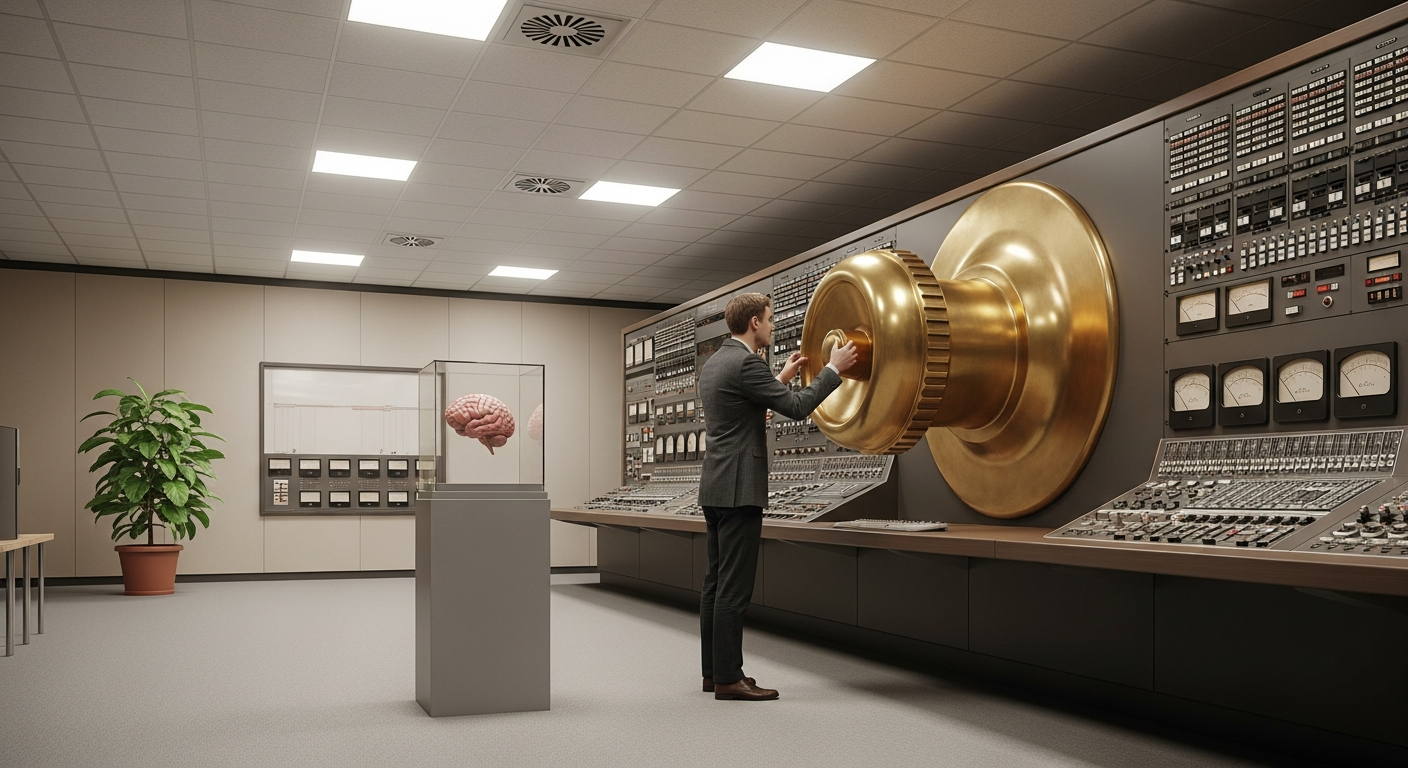
It turns out your brain has a volume knob, and scientists just found it behind a very small piece of RNA.
Scientists have discovered that a specific type of brain cell in your amygdala — not a neuron, but the humble astrocyte, the cell everyone assumed was just holding the furniture in place — is actively tracking your anxiety like a tiny, biological worry journal. Not only are these cells *recording* your dread, they are apparently *causing* it. The astrocytes are not bystanders. They are the management.
Takeaway
Your anxiety has a paper trail, and the paperwork is being filed by cells science spent decades ignoring.
Science Confirms Kids' Brains Are Broken in a Completely Different Way Than Adults' Brains
Journal of Neuroscience · 2026-03-21
Researchers scanned brains aged 8 to 25 and found that when rewards are involved, adults remember things by keeping their brain patterns stable — like a filing cabinet that stays organized. Kids, meanwhile, remember things better when their brain patterns drift all over the place. So adults remember because their brains hold still. Children remember because their brains wander off and somehow return with the right answer. These are, scientifically speaking, opposite strategies, and both of them work.
Takeaway
The adult brain is a locked vault. The child brain is a golden retriever that somehow brings back exactly what you asked for.
The Nerve Poison That Moonlights as an Immune System Hype Man
Neuron · 2026-07-12
6-OHDA is a chemical scientists use to destroy nerve tissue on purpose — a real "we do this for science" compound. Its whole job, as far as anyone knew, was killing neurons. But researchers just found it has a side hustle: making cancer cells panic, triggering a chain reaction that turns the immune system into a tumor-hunting machine. The cancer cells release a distress signal, which recruits a special class of souped-up macrophages, which then organize the immune system to go to war. The nerve poison was running a whole immune activation operation the entire time and nobody checked.
Takeaway
6-OHDA has been destroying neurons for decades while quietly being better at immunology than most things designed to do immunology.
Scientists Scrambled the Alphabet to See If Your Brain Would Panic
Biorxiv · 2026-03-25
Researchers took letters, ran them through a visual blender meant to simulate glitches deep inside the human eye-to-brain pipeline, and then asked people to read them anyway. The good news: your brain handles "orientation-redundant" scrambling pretty well. The bad news: "orientation-noisy" scrambling — where the brain's earliest signal lines get their wires crossed — turns letters into visual chaos that even a neural network finds rough going. Essentially, scientists discovered that your brain has a preferred flavor of broken.
Takeaway
Your visual system is fine with blurry. It is not fine with scrambled. There is a difference, and your neurons have opinions about it.
Your Hand Already Knows It Made a Mistake Before You Do
Journal of Neuroscience · 2026-03-21
Scientists have discovered that your hand has a bouncer. The moment something unexpected happens — a target moves, a light flickers, basically anything — your motor system slams the brakes on whatever your hand was about to do. It doesn't ask you first. It doesn't check your feelings about it. It just freezes your hand in place for a few hundred milliseconds while the rest of your brain figures out what went wrong. The bouncer doesn't even care if the distraction was relevant. A random flash of light is enough to get your hand put on hold. Your hand, it turns out, is being managed.
Takeaway
Your motor system runs a tighter operation than you do.
Nicotine Gum Slightly Reduces Pain, For Completely Unknown Reasons
Biorxiv · 2026-03-19
Scientists gave people nicotine gum, measured their brainwaves, and poked them with heat and pressure until they said ouch. The nicotine group felt a little less pain. Their brains also changed in a measurable way. Crucially, the brain change had absolutely nothing to do with the pain change. Two things happened. Neither caused the other. The researchers wrote this up and submitted it to a journal.
Takeaway
Science has confirmed that nicotine gum does something, somewhere, for some reason, and the investigation continues.
An AI Figured Out Consciousness and Nobody Is Talking About This
Nature Neuroscience · 2026-03-25
Scientists built an AI, pointed it at the human brain, and asked it to figure out why we're sometimes conscious and sometimes not. The AI — which, to be clear, is not conscious — obliged. It identified the mechanisms behind consciousness, predicted new ways a brain can go dark, and then, almost as an afterthought, recommended zapping a specific part of the brain to bring people back. The part is called the subthalamic nucleus. The AI knew exactly where it was. You did not.
Takeaway
A machine that has never once been awake is now our best lead on how to wake people up.
Phylogenetic Generalised Least Squares As A Robust Causal Inference Method, 1990s – 2024
Phylogenetic Generalised Least Squares regression proposed that evolutionary associations between traits could be estimated reliably across species while accounting for shared ancestry, offering comparative biologists a principled and statistically defensible framework for their analyses. It was widely adopted across ecology and evolutionary biology, becoming a standard tool in the assessment of trait coevolution and the construction of adaptive hypotheses. For several decades it occupied a position of considerable methodological authority, appearing in thousands of comparative studies and forming the backbone of graduate training in the field. Its decline began as researchers examined the sensitivity of the method's conclusions to the assignment of variables to the dependent and independent positions — a choice that, in a genuinely robust method, ought not to determine the outcome. The terminal finding demonstrated that reversing the dependent and independent variables in a substantial proportion of published PGLS analyses yielded inconsistent or contradictory conclusions, revealing that the method had been bearing a causal interpretive weight it was not constructed to support.
Cause of death
Demonstrated asymmetry of results under variable reversal across a substantial proportion of cases, establishing that the method's conclusions were sensitive to an analytical choice that causal inference requires to be inconsequential.
Survived by
It is survived by phylogenetic comparative methods more broadly, the emerging framework of causal inference in evolutionary biology, alternative regression approaches less susceptible to directional sensitivity, and a considerable body of published literature whose conclusions are now under quiet reassessment.
It brought statistical rigour to the comparison of traits across species at a time when the alternative was largely informal, and the questions it helped researchers ask remain among the most important in evolutionary biology.
Note
The associations PGLS identified were real enough; the causal directions it appeared to endorse were a different matter entirely.
No tracking. No ads. No cookies. Your email is only used to deliver the newsletter. Theme preference is stored locally in your browser.
Privacy policy →