Philosophy
TheoryBasic science
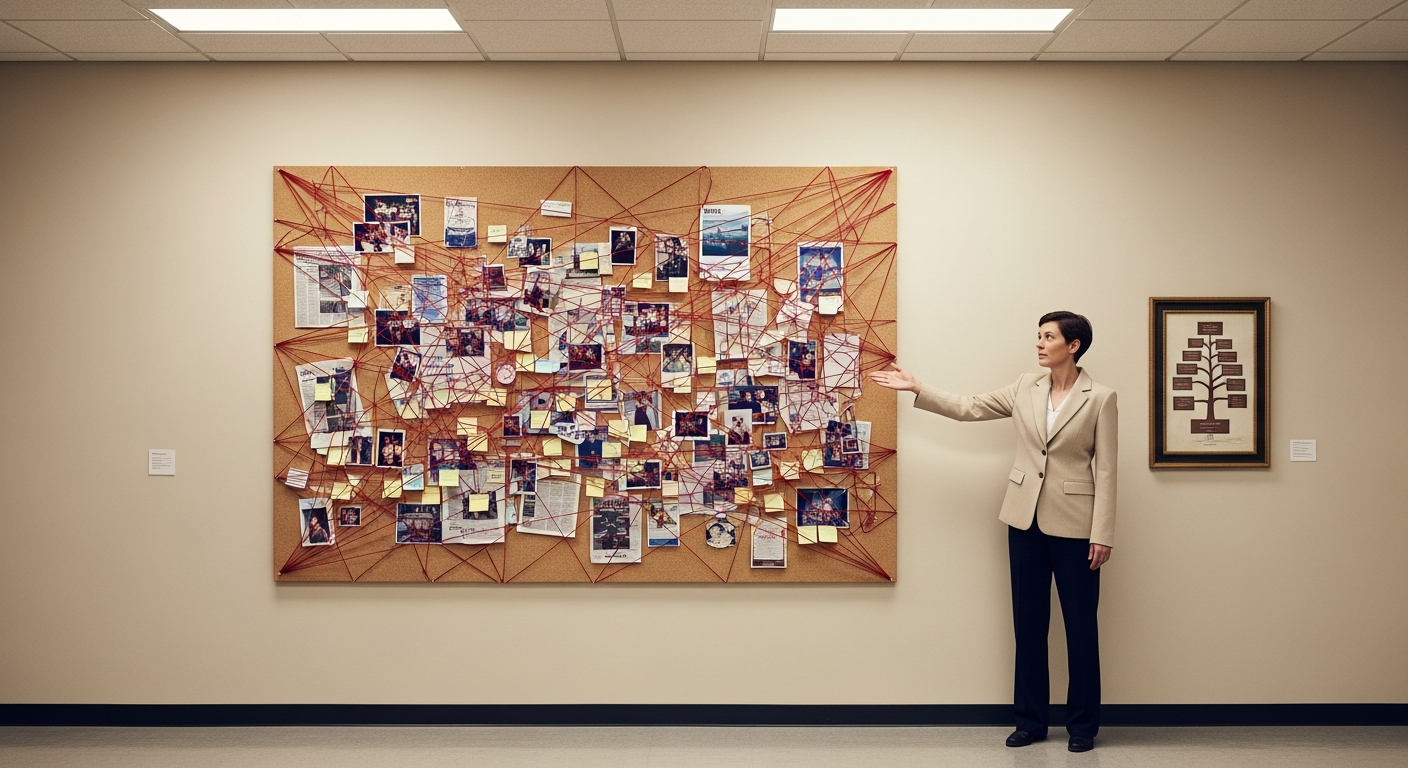
Science Confirms Humans Are Connected, But Like, In A Chart Way
Synthese · 2026-03-12
For centuries, scientists drew family trees to explain how cultures pass down their weird hats and weirder rituals. Then someone looked at the trees and said: "What if it was more of a web." Researchers have now spent serious academic time confirming that yes, networks — the tangled, looping, everything-connects-to-everything diagrams — can explain cultural evolution at least as well as trees can. The trees, for the record, had a good run.
Takeaway
Humanity's entire cultural inheritance is basically a group chat, and the family tree was just a very confident wrong answer.
Read paper ↗
Philosophy
TheoryBasic science
Philosophers Spent Years Arguing About What Words Mean, Then Argued About That Too
Synthese · 2026-03-23
Science has a naming problem. Not a "we called it a dwarf planet and everyone got upset" problem — a deeper, more philosophical problem about what scientific words even *mean* and what they're pointing at. A new paper has a fix: take the existing theory about how words refer to things, and refine it. The refinement, naturally, required its own theory. We have now reached the part of philosophy where the ladder goes all the way down and there is no floor.
Takeaway
The word "electron" means something, scientists are pretty sure, and philosophers are on it.
Read paper ↗
Philosophy
TheoryBasic science

Philosophers Have Figured Out How We Know Things Can Happen
Synthese · 2026-03-23
A new philosophical theory proposes that the way humans learn what's possible and what's necessary — the deep, cosmic stuff, like "it's possible it could rain" or "triangles must have three sides" — comes down to surprise. You get surprised, your brain updates its model of reality, and suddenly you know more about the possible. This is a real theory. It was published. Peer review looked at it and said: yes, surprise, that tracks.
Takeaway
Millennia of philosophy, and the answer to "how do we know what's possible" is basically "stuff caught us off guard."
Read paper ↗
Philosophy
Basic science
Scientists Confirm They Are Still Looking For The Thing
Synthese · 2026-03-23
Particle physicists have released a paper about searching for particles. The method involves measuring things very precisely, feeding the numbers into a computer, and then — and this is the key innovation — also searching high. And low. The full vertical range of existence has been covered. They even brought in machine learning, which means a robot is now equally unsure what it found.
Takeaway
The universe is hiding something, science has a very sophisticated net, and so far the universe is winning.
Read paper ↗
In Memoriam
Phylogenetic Generalised Least Squares As A Robust Causal Inference Method, 1990s – 2024
Phylogenetic Generalised Least Squares regression proposed that evolutionary associations between traits could be estimated reliably across species while accounting for shared ancestry, offering comparative biologists a principled and statistically defensible framework for their analyses. It was widely adopted across ecology and evolutionary biology, becoming a standard tool in the assessment of trait coevolution and the construction of adaptive hypotheses. For several decades it occupied a position of considerable methodological authority, appearing in thousands of comparative studies and forming the backbone of graduate training in the field. Its decline began as researchers examined the sensitivity of the method's conclusions to the assignment of variables to the dependent and independent positions — a choice that, in a genuinely robust method, ought not to determine the outcome. The terminal finding demonstrated that reversing the dependent and independent variables in a substantial proportion of published PGLS analyses yielded inconsistent or contradictory conclusions, revealing that the method had been bearing a causal interpretive weight it was not constructed to support.
It brought statistical rigour to the comparison of traits across species at a time when the alternative was largely informal, and the questions it helped researchers ask remain among the most important in evolutionary biology.
Note
The associations PGLS identified were real enough; the causal directions it appeared to endorse were a different matter entirely.